Free Pharmaceutical Quality Assurance (QA) Course
With Free Certificate — Pharma Lesson Masterclass
Master essential industrial competencies in Quality Assurance (QA), cGMP, ALCOA+ Data Integrity, In-Process Quality Control (IPQC), Line Clearance, and CAPA. Complete all modules, clear the 80% final assessment, and download your verified certificate of achievement.
Build Core Competencies in Pharmaceutical QA & Compliance
In the pharmaceutical industry, “Quality cannot be tested into a finished product; it must be built in by design.” Quality Assurance (QA) is the central operational pillar ensuring every pharmaceutical batch manufactured is consistently safe, effective, pure, and fully compliant with global regulatory bodies like the US FDA, EMA, MHRA, and CDSCO.
- Master ALCOA+ data integrity to prevent critical FDA 483 audit citations
- Understand on-floor plant QA: Line clearance checklists & IPQC testing
- Explore modern QMS workflows: Deviation investigations & CAPA implementation
- Earn a verified Certificate of Achievement with Credential ID for LinkedIn & CV

Quality Assurance (QA) vs Quality Control (QC)
A classic technical interview question for freshers! Here is how the two critical quality departments function across pharma operations:
Quality Assurance (QA)
- •Proactive & Process-Oriented: Focuses on building, monitoring, and standardizing systems to prevent defects before they happen.
- •Core Functions: SOP development, Line clearance oversight, Deviation handling, CAPA, Batch release, Quality Audits & Compliance training.
- •Guiding Philosophy: “Right first time, every time” across the entire product development and manufacturing lifecycle.
Quality Control (QC)
- •Reactive & Product-Oriented: Focuses on testing, inspecting, and analyzing physical laboratory samples to detect defects against standards.
- •Core Functions: Raw material analysis, HPLC/GC chromatography, dissolution testing, stability testing, and microbial limit testing.
- •Guiding Philosophy: Verifying batch conformity against Pharmacopoeial monographs (IP, USP, BP, EP).
Studying B.Pharm Semester 5 Quality Assurance?
This course aligns directly with your BP505T Pharmaceutical Quality Assurance university syllabus! Pair this certification with our unit-wise notes, chapter breakdowns, and question banks.
What You Will Learn in This Course
The Pharma Lesson Quality Assurance curriculum is structured into 6 focused modules covering core industrial compliance and operational standards:
Introduction to QA, Philosophy & ALCOA+ Principles
Covers the fundamental definitions, evolution, and core philosophy of Quality Assurance. Deep-dives into data integrity standards governed by the ALCOA+ framework (Attributable, Legible, Contemporaneous, Original, Accurate + Complete, Consistent, Enduring, Available).
Good Practices (GxP Spectrum): GMP, GLP & GDP
Explores the international GxP landscape governing pharmaceutical manufacturing operations. Outlines current Good Manufacturing Practices (cGMP 21 CFR Part 211 / EU GMP), Good Laboratory Practices (GLP), and Good Distribution Practices (GDP).
In-Process Quality Control (IPQC) & Line Clearance
Practical operational QA on the manufacturing plant floor. Focuses on line clearance verification checklists before starting batches, in-process testing during granulation/compression/coating, and cleanroom air handling (Grade A/B/C/D).
Quality Management Systems (QMS): Deviations & CAPA
Mastering modern pharmaceutical QMS workflows. Covers deviation classification (Minor, Major, Critical), structured Root Cause Analysis (5 Whys and Fishbone Ishikawa diagram), and Corrective & Preventive Action (CAPA) tracking.
Audits, Regulatory Inspections & FDA 483 Responses
Understanding internal self-inspections, vendor/supplier audits, and official inspections hosted for regulatory authorities including US FDA, EMA, MHRA, WHO GMP, and India's CDSCO.
Process Validation, Batch Release & Product Recalls
Examines process validation stages (Process Design, Process Qualification, Continued Process Verification), Master Batch Record (BMR/BPR) review, Qualified Person (QP) market release, and product recall classifications (Class I, II, III).
How to Clear the Final Test & Qualify for the Certificate
To maintain credential quality and professional validity, Pharma Lesson requires all enrolled candidates to complete all video modules and achieve a minimum passing score of 80% on the final assessment quiz.
- Assessment Format: Multiple Choice Questions (MCQs) covering real-world QA scenarios.
- Passing Threshold: 80% or higher. Free re-attempts are permitted if required.
- Instant Credential Release: The ‘View Certificate’ button unlocks automatically upon passing.
Test Your QA Knowledge Before the Final Test
The official Pharma Lesson assessment requires an 80% minimum passing score. Practice with these representative questions:
1. What is the primary difference between Quality Assurance (QA) and Quality Control (QC)?
2. In the ALCOA+ Data Integrity framework, what does 'C' stand for?
3. What is the mandatory first step before starting a new manufacturing or packaging batch in pharma?
How to Complete the Course & Claim Your Certificate
Follow these 5 simple steps on the official Pharma Lesson platform to get certified:
Open Official Portal
Visit the Pharma Lesson Masterclass course page using the direct link provided below.
Create Free Account
Register a free student profile using your active email address and name.
Click 'Enroll'
Click the Enroll button to immediately unlock all video lessons and learning material.
Pass Final Test (≥ 80%)
Complete all video modules and score 80% or higher on the end-of-course assessment.
Download Certificate
Click 'View Certificate' to download your verified certificate in PDF or Image format!
Share Your Certificate on LinkedIn & Tag @PharmaCode
When you celebrate your achievement on LinkedIn, remember to tag and mention PharmaCode (@pharmacode-edu) in your post! Tagging us automatically qualifies you for Free Mentorship, Personalized Resume & LinkedIn Reviews, 1-on-1 Career Guidance, and priority updates on upcoming pharma job drives from our team.
Free Mentorship
Direct 1-on-1 career guidance & interview prep support.
Recruiter Reach
Boost post reach & visibility among pharma hiring managers.
CV & Resume Review
Actionable suggestions to optimize your pharma profile.
🎉 Excited to share that I have successfully completed the "Introduction to Pharmaceutical Quality Assurance" professional certification course from Pharma Lesson Masterclass!

Key competencies & industrial learnings:
• cGMP guidelines (21 CFR Part 211), GLP & GDP regulatory framework
• ALCOA+ Data Integrity Standards & US FDA audit readiness
• Line clearance verification & In-Process Quality Control (IPQC) protocols
• Quality Management Systems (QMS), Deviations, Root Cause Analysis (5 Whys / Fishbone) & CAPA lifecycle
• Process Validation stages (Stage 1-3) & Master Batch Record (BMR) review

A big thank you to PharmaCode (@pharmacode-edu) for sharing this valuable free certification resource and study guide! 🚀

#PharmaceuticalQualityAssurance #GMP #QualityAssurance #PharmaCode #BPharm #MPharm #PharmaCareers #DataIntegrity #CAPA #PharmaJobs
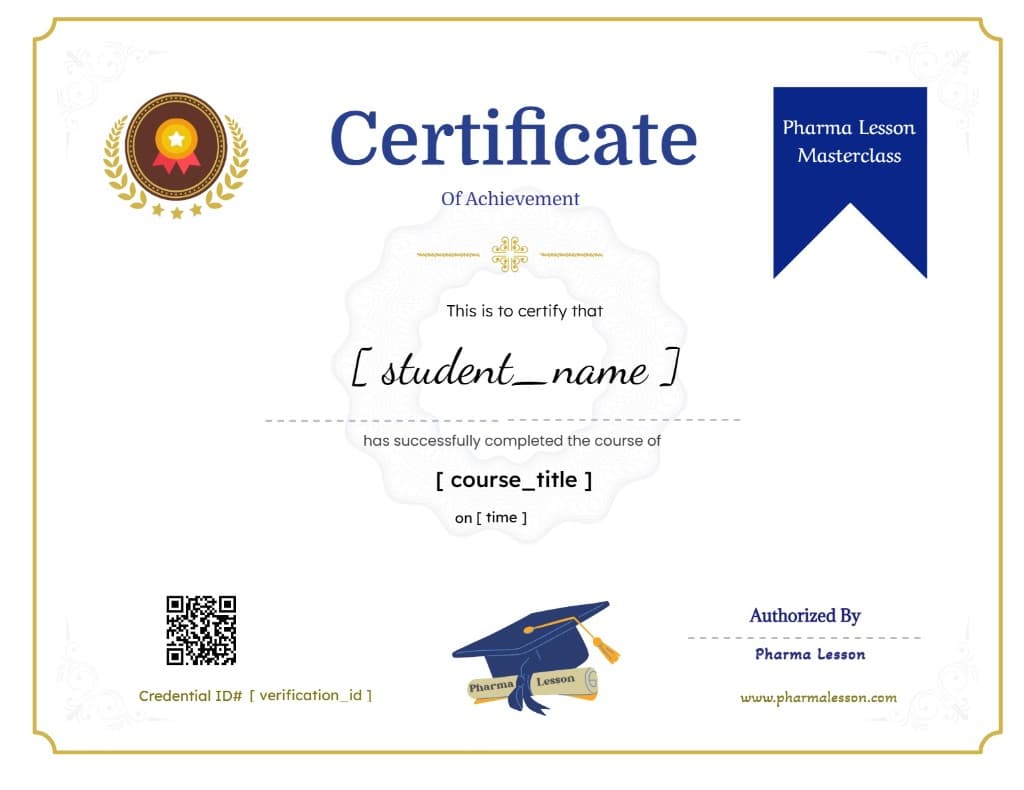
Sample Certificate of Achievement
Here is an official sample preview of the verified certificate you will receive upon completing all course modules and passing the 80%+ final assessment:
Certificate Features
- Student Name & Title: Personalized with your registered full name and course title.
- Credential ID & QR Code: Verifiable credential ID for LinkedIn and your professional CV.
- Dual Format Download: High-resolution Image (.PNG) and Print-ready PDF.
- 100% Free: No charges for course enrollment or certificate generation.
Pharmaceutical QA Career Roles & Salary in India
Quality Assurance offers stable, highly respected career ladders with extensive exposure to global regulatory compliance:
IPQC / QA Officer (Fresher)
0 - 2 Years Exp | ₹2.8L - ₹4.5L LPAResponsible for on-floor line clearance verification, in-process sampling, environmental monitoring, and BMR record auditing.
QMS / CAPA Specialist
3 - 6 Years Exp | ₹5.5L - ₹9.0L LPAManages deviations, conducts structured Root Cause Analysis (RCA), executes CAPAs, and manages facility change controls.
QA Manager / Head of Quality
8+ Years Exp | ₹12L - ₹25L+ LPAOversees total plant compliance, leads US FDA / EMA audit hosting, authorizes market batch releases, and oversees validation.
Frequently Asked Questions
QIs this Pharmaceutical Quality Assurance course and certificate completely 100% free?
Yes! The 'Introduction to Pharmaceutical Quality Assurance' course offered on the Pharma Lesson Masterclass portal is 100% free of cost. There are no registration fees, hidden subscriptions, or certificate download charges.
QWhat is the minimum score required to obtain the certificate?
To earn your certificate of achievement, you must complete all video modules and score a minimum of 80% on the final assessment quiz. Once you pass with 80% or higher, the 'View Certificate' button unlocks automatically.
QCan I retake the final assessment if I score below 80%?
Yes! If you do not pass on your first attempt, you can review the study lessons and retake the final test until you achieve the required 80% score.
QDoes the certificate include a verifiable Credential ID for LinkedIn and CV?
Yes! Every downloaded certificate (available in high-resolution image and PDF formats) features a unique Credential Verification ID, date of completion, and QR code that employers can cross-verify.
QHow does this certification help B.Pharm and M.Pharm students?
Pharmaceutical Quality Assurance is a mandatory subject in B.Pharm Semester 5 (BP505T) and M.Pharm QA curricula. Adding this verified certificate demonstrates proactive industry knowledge to recruiters for roles like QA Officer, IPQC Chemist, and QMS Specialist.
QWhat is the fundamental difference between QA and QC in pharmaceutical plants?
Quality Assurance (QA) is a proactive, process-oriented function focused on designing systems and standard operating procedures to prevent defects. Quality Control (QC) is a reactive, product-oriented laboratory function that conducts physical and chemical tests on samples to detect defects against pharmacopoeial standards.